

Ulcerative Colitis Market to reach USD 17.82 Billion by 2035 at 4.68% CAGR
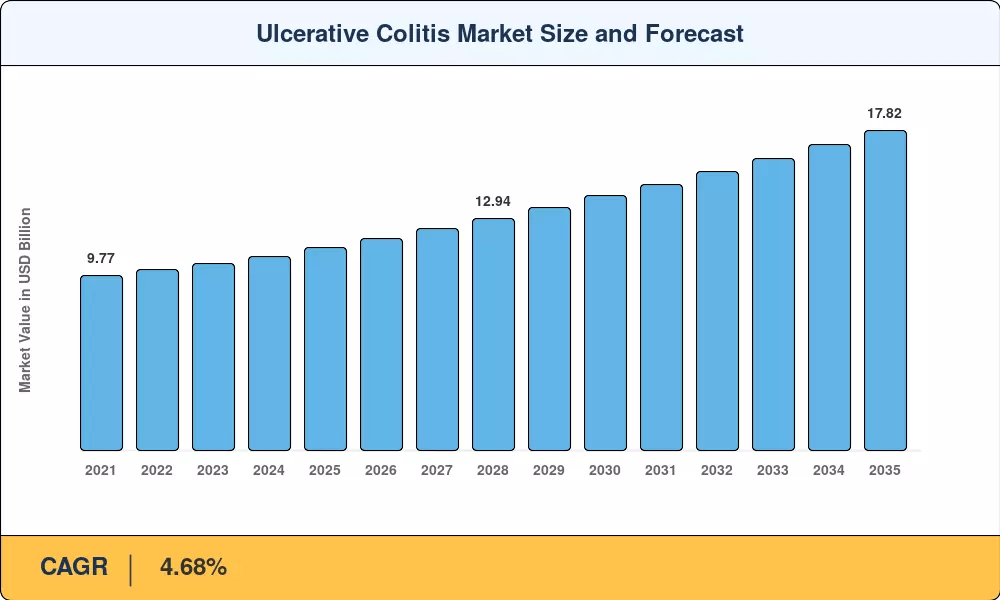
Ulcerative Colitis Market Size
Ulcerative Colitis Market to Surge from USD 11.81 Bn in 2026 to USD 17.82 Bn by 2035-By Rising Global IBD Incidence, JAK Inhibitor & S1P Class Expansion
NY, CA, UNITED STATES, June 16, 2026 /EINPresswire.com/ -- As per Market Research Future, the global Ulcerative Colitis Market size to reach USD 17.82 Billion by 2035 from USD 11.81 Billion in 2026, at a CAGR of 4.68% during the forecast period 2026--2035. The market base was estimated at USD 11.28 Billion in 2025.The 4.68% CAGR---anchored by structural chronic disease demand rather than discretionary healthcare spending---is driven by three converging forces: rising global incidence of inflammatory bowel disease therapy needs that continue to widen the addressable patient base, sustained JAK inhibitor and S1P receptor modulator class expansion that has pulled oral advanced therapy into routine ambulatory care, and biosimilar-driven budget reallocation that has freed payer budgets for premium next-generation agents while expanding access to established biologics for colitis.
National governments and multilateral health organizations are amplifying this momentum. The Global Burden of Disease Study 2024 indicates a 35% increase in age-standardized inflammatory bowel disease therapy demand across newly industrialized nations since 2010. The U.S. Inflation Reduction Act's drug price negotiation provisions have reshaped payer dynamics for chronic gastrointestinal conditions, capping out-of-pocket biologic costs at USD 2,000 for Medicare patients.
Patient advocacy organizations have simultaneously driven faster diagnosis rates, compressing the time from symptom onset to treatment initiation and expanding the addressable treatment population. China's 2024 NRDL update included three biologic medicines for UC, extending insurance coverage to an anticipated 45 million eligible patients. Together, these initiatives are creating the procurement infrastructure and delivery innovation on which the Ulcerative Colitis Market depends.
Request A Free Sample:
https://www.marketresearchfuture.com/sample_request/2354
Key Market Trends & Growth Drivers
Rising Global IBD Incidence and Diagnosis Expansion
Epidemiological surveillance data from the Global Burden of Disease Study 2024 indicate a 35% increase in age-standardized inflammatory bowel disease therapy demand across newly industrialized nations since 2010. Dietary westernization, urbanization, and improved diagnostic endoscopy access have pushed UC prevalence beyond 500 per 100,000 in parts of Northern Europe, while incidence in China's eastern provinces now rivals rates seen in Western populations two decades ago. This structural expansion of the patient pool underpins long-term volume growth in the Ulcerative Colitis Market regardless of per-patient pricing trends. Each percentage point of diagnosis rate gain translates into measurable prescription volume, and the colon inflammation treatment schedule embedded in routine gastroenterology care makes this driver structurally durable through 2035.
Patient advocacy organizations have driven faster diagnosis rates, compressing the time from symptom onset to treatment initiation and expanding the addressable treatment population. Early-adopter health systems report that treat-to-target protocols mandate escalation based on objective endoscopic and histologic endpoints rather than symptom scores alone, favoring agents with proven mucosal healing data and accelerating adoption of IL-23 inhibitors for IBD remission induction. The shift toward subcutaneous self-injection is gradually decentralizing biologics for colitis distribution from infusion centers to home-based care, expanding the addressable channel.
JAK Inhibitor & S1P Class Expansion and Oral Convenience
Legacy anti-TNF biologics, which dominated colon inflammation treatment for over a decade, are yielding share to oral JAK inhibitors and IL-23 monoclonal antibodies that offer targeted IBD remission induction with more convenient dosing. Tofacitinib's 2018 approval opened the oral advanced therapy category, but upadacitinib and filgotinib have since broadened the class with improved selectivity profiles and reduced safety signals.
The FDA's 2024 label update removing boxed warnings from select JAK agents boosted prescriber confidence, and real-world registry data show 60-day clinical remission rates exceeding 45% in moderate-to-severe patients---directly competing with parenteral biologics for colitis. Ozanimod and etrasimod, both S1P receptor modulators, added further oral competition, enabling IBD remission induction without immunosuppression-related infection risk.
Pooled procurement through national health systems drives per-unit prices down for high-volume mesalamine bowel therapy, expanding access while compressing manufacturer margins. The oral convenience of JAK inhibitors and S1P modulators---previously unavailable in the advanced therapy space---provides rapid symptom control often within two weeks compared to 8--14 weeks for biologic onset.
Biosimilar-Driven Budget Reallocation and IL-23 Pipeline Maturation
The European biosimilar market for adalimumab and infliximab generated estimated savings of USD 4.2 Billion between 2018 and 2024 across all indications. In UC specifically, payers have redirected freed budgets toward premium IL-23 agents and combination induction strategies. The 2025 U.S. launch of interchangeable biosimilar infliximab products is expected to amplify this dynamic, with CMS projecting 8--12% net unit cost reductions in the first two years of competitive market entry for colon inflammation treatment. Biosimilar entrants have eroded anti-TNF pricing by an estimated 30--45% in competitive markets, freeing payer budgets for premium next-generation agents.
Risankizumab's UC approval in late 2023 and mirikizumab's commercial ramp have established the IL-23 class as a cornerstone of mesalamine bowel therapy-refractory management. Phase III data show mucosal healing rates above 35% at one year---a benchmark that shifts treatment goals from symptom control toward deep remission. AbbVie reported USD 1.9 Billion in combined IBD revenue from risankizumab in its 2024 annual filing, signaling rapid clinical adoption in the Ulcerative Colitis Market. The VEGA trial demonstrated that dual biologic induction (guselkumab plus golimumab) achieved endoscopic improvement rates of 49.1%, far exceeding monotherapy and opening a high-value niche for IBD remission induction protocols.
Ask for Customization:
https://www.marketresearchfuture.com/ask_for_customize/2354
Market Segment Insights
BY DRUG TYPE
Anti-TNF Biologics: Dominant segment with ~40.5% revenue share in 2025. Reflecting established efficacy data and biosimilar access. Infliximab and adalimumab biosimilars now represent over 60% of anti-TNF prescriptions in Europe, generating substantial cost savings that payers redirect toward advanced therapies. Clinical familiarity, long-term safety databases spanning 20+ years, and established dosing protocols ensure anti-TNF agents retain a significant prescriber base for moderate-to-severe colon inflammation treatment. Humira and Remicade anchor this segment.
JAK Inhibitors: Fastest-growing drug class at 14.72% CAGR (2026--2035). Tofacitinib, upadacitinib, and filgotinib provide rapid symptom control---often within two weeks---compared to 8--14 weeks for biologic onset. Oral convenience previously unavailable in the advanced therapy space expands the treatable population in outpatient settings. As JAK inhibitor adoption accelerates across severity segments, manufacturers able to supply selective agents with favorable safety profiles capture a disproportionate share.
BY DISEASE TYPE
Pancolitis: Dominant application with ~32.2% share in 2025. Reflecting the highest biologic utilization rate. The widespread mucosal involvement necessitates systemic biologic therapy rather than topical approaches. Patients with pancolitis consume an estimated 2.4x more pharmaceutical resources per year than those with distal disease, driven by higher rates of hospitalization, rescue therapy, and eventual colectomy.
Fulminant Colitis: Fastest-growing disease segment at 9.05% CAGR (2026--2035). Driven by intensive colon inflammation treatment protocols that deploy combination biologics and calcineurin inhibitors to avoid emergency surgery. While representing a smaller patient population, fulminant colitis is growing fastest due to intensified inflammatory bowel disease therapy protocols.
Left-Sided Colitis: 24.6% share in 2025. Biologic escalation threshold drives demand for systemic therapy when topical mesalamine bowel therapy fails.
Ulcerative Proctitis: USD 1.92 Billion in 2025. Topical mesalamine bowel therapy dominance in distal disease.
Proctosigmoiditis: Growing segment at 4.25% CAGR (2026--2035). Combination oral-rectal regimens drive demand.
BY ROUTE OF ADMINISTRATION
Parenteral: Dominant route with ~70.2% revenue share in 2025. The highest-revenue drug classes---anti-TNF, IL-23, and integrin inhibitors---all require intravenous or subcutaneous delivery. The shift toward subcutaneous self-injection is gradually decentralizing biologics for colitis distribution from infusion centers to home-based care.
Oral: USD 3.28 Billion in 2025. Aminosalicylates and JAK inhibitors drive oral segment demand. The next frontier lies in oral formulations of monoclonal antibodies using permeation-enhancing nanotechnology carriers for IL-23 agents, potentially eliminating injection burden entirely by 2030--2032.
Rectal: Growing segment at 8.73% CAGR (2026--2035). Targeted distal disease delivery drives demand, with mesalamine enemas and suppositories experiencing renewed interest as treat-to-target strategies emphasize topical colon inflammation treatment.
BY DISTRIBUTION CHANNEL
Hospital Pharmacies: Largest segment at ~45.7% share in 2025. Specialist-supervised biologic initiation and cold-chain storage requirements dominate volume, channeling routine inflammatory bowel disease therapy supply.
Online Pharmacies: Fastest-growing channel at 9.45% CAGR (2026--2035). Payer-mandated specialty pharmacy networks for IBD remission induction agents and patient preference for home delivery of maintenance medications drive demand.
Read Detailed Insights:
https://www.marketresearchfuture.com/reports/ulcerative-colitis-market-2354
Regional Outlook
North America -- Dominant Market (~46.2% Share, 2025)
The United States generates approximately 82.5% of North American Ulcerative Colitis Market revenue, driven by high per-patient biologic expenditure averaging USD 35,000--55,000 annually and a mature specialty pharmacy ecosystem---a single policy shift that converted a symptom-management-dominated market into one with a structural biologic tail. Medicare Part D redesign under the Inflation Reduction Act caps out-of-pocket biologic costs at USD 2,000, removing a critical adherence barrier for biologics for colitis among elderly patients. The US dominates through a combination of specialist gastroenterology networks, favorable biologic reimbursement, and rapid adoption of novel mechanisms of action.
Europe -- Second Largest (USD 2.99 Billion, 2025)
Europe's Ulcerative Colitis Market reflects divergent national strategies---Germany leads regionally with G-BA benefit assessment fast-tracks, growing at 6.12% CAGR, while the UK historically used selective biologic targeting before broadening coverage through NICE technology appraisals, contributing ~21.8% of regional share. France contributes USD 0.49 Billion through early access program biologics. Italy is growing at 5.45% CAGR on AIFA therapeutic plans. Spain contributes USD 0.31 Billion on regional health service budgets.
Asia-Pacific -- Fastest-Growing Region (7.76% CAGR, 2026--2035)
Asia-Pacific is the engine of the Ulcerative Colitis Market. China is growing at 8.35% CAGR on NRDL biologic additions---the 2024 NRDL update included three biologic medicines for UC, extending insurance coverage to an anticipated 45 million eligible patients. China's centralized procurement program has reduced infliximab pricing by approximately 55% since 2021, dramatically expanding access to colon inflammation treatment across tier-two and tier-three cities. India contributes USD 0.22 Billion through gastroenterology workforce expansion. Japan holds ~28.4% of regional share on NHI price revisions at steady pace.
Middle East & Africa -- Emerging Opportunity (5.82% CAGR, 2026--2035)
The Middle East & Africa carries the widest access gap and therefore the steepest opportunity. Saudi Arabia leads the region with Vision 2030 health investment, contributing ~34.8% of regional share---the National Transformation Program earmarks USD 65 Billion for health system transformation, including gastroenterology center expansion and inflammatory bowel disease therapy coverage enhancement. The UAE is growing at 5.95% CAGR on medical free-zone pharma hubs. South Africa contributes USD 0.06 Billion on private formulary biologics.
South America -- Growing Presence (USD 0.59 Billion, 2025)
Brazil anchors South America's Ulcerative Colitis Market at ~62.3% of regional revenue, with the Sistema Único de Saúde (SUS) incorporating vedolizumab and ustekinumab into its biologics for colitis formulary in 2023, expanding public-sector access and providing a stable demand floor that smooths regional forecasts. Argentina is growing at 5.15% CAGR on ANMAT regulatory modernization.
Competitive Landscape and Recent Developments
The Ulcerative Colitis Market is moderately concentrated, with an estimated Herfindahl-Hirschman Index in the 1,200--1,500 range and the top five suppliers holding roughly 55--65% of global revenue. Concentration is highest in high-income segments where regulatory and clinical trial barriers are steep; the biosimilar tier is more fragmented as regional producers compete on price.
The competitive landscape is stratified between premium biopharmaceutical incumbents serving specialty markets, biosimilar suppliers capturing tender-driven volume, and mid-cap innovators consolidating the novel mechanism-of-action segment.
KEY COMPANIES AND RECENT MILESTONES
AbbVie (2024--2025): Maintains leadership with risankizumab and adalimumab, commanding ~12--16% of global Ulcerative Colitis Market revenue. IL-23 franchise leader with USD 1.9 Billion in combined IBD revenue from risankizumab in its 2024 annual filing. Premium biologic positioning in specialty segments offsets biosimilar price compression in competitive markets.
Johnson & Johnson (Janssen) (2024--2025): Guselkumab, golimumab, and infliximab anchor a strong North America franchise, holding ~10--14% of global revenue. Dual biologic induction pioneer with the VEGA trial demonstrating endoscopic improvement rates of 49.1%. The company benefits from the structural biologic tail created by expanded treat-to-target protocols.
Takeda (2024--2025): Maintains vedolizumab (IV/SC) portfolio, commanding ~9--13% of global revenue. Gut-selective integrin leader serving hospital and specialty pharmacy channels globally. Subcutaneous self-administration platform captured more than 25% of new starts within 12 months of launch.
Pfizer (2024--2025): Tofacitinib and etrasimod anchor a strong oral small molecule franchise, holding ~8--12% of global revenue. Oral convenience portfolio benefits from the structural ambulatory care transition away from infusion centers.
Future Outlook: 2026--2035
By 2030, oral biologic revolution will become the operating system of colon inflammation treatment. The next frontier for the Ulcerative Colitis Market lies in oral formulations of monoclonal antibodies. Early-phase clinical programs using permeation-enhancing nanotechnology carriers for IL-23 agents could eliminate injection burden entirely by 2030--2032, disrupting both subcutaneous and intravenous delivery models. Successful oral biologic development would fundamentally reshape distribution channel dynamics, shifting revenue from hospital pharmacies toward retail and online channels for colon inflammation treatment. Machine learning algorithms trained on electronic health record data from over 500,000 UC patients are demonstrating the ability to predict biologic response with 78% accuracy before treatment initiation, potentially reducing treatment failure rates by 25--30%.
AI-driven treatment optimization and precision biomarker-guided therapy selection will reframe cost structures by the early 2030s. Pharmacogenomic testing to inform thiopurine metabolism (TPMT/NUDT15) has already decreased adverse events, but multi-omic panels combining proteomic and microbiome markers are promising to predict biologic response before treatment beginning. Companies investing in companion diagnostics for IL-23 and JAK agents can leverage premium price tiers in the Ulcerative Colitis Market. Integration of AI tools into clinical decision support systems could reduce treatment cycling costs by 20--30% and improve mesalamine bowel therapy escalation decisions. As per-patient costs fall with predictive accuracy, the addressable channel widens from specialty centers to community gastroenterology practices.
More Related Research Insights:
https://www.marketresearchfuture.com/reports/inflammatory-bowel-disease-treatment-market-6266
https://www.marketresearchfuture.com/reports/crohns-disease-market-2344
https://www.marketresearchfuture.com/reports/gastrointestinal-drugs-market-558
https://www.marketresearchfuture.com/reports/biologics-market-1339
https://www.marketresearchfuture.com/reports/autoimmune-disease-treatment-market-5586
https://www.marketresearchfuture.com/reports/digestive-health-products-market-2519
https://www.marketresearchfuture.com/reports/biosimilars-market-1329
https://www.marketresearchfuture.com/reports/colorectal-cancer-screening-market-9203
https://www.marketresearchfuture.com/reports/precision-medicine-market-925
https://www.marketresearchfuture.com/reports/microbiome-therapeutic-market-43454
Larry Wilson
WantStats Research And Media Pvt. Ltd.
+1 855-661-4441
email us here
Visit us on social media:
LinkedIn
Facebook
YouTube
X
Legal Disclaimer:
EIN Presswire provides this news content "as is" without warranty of any kind. We do not accept any responsibility or liability for the accuracy, content, images, videos, licenses, completeness, legality, or reliability of the information contained in this article. If you have any complaints or copyright issues related to this article, kindly contact the author above.
