

Water Quality Sensor Market Grow From USD 5.17 Billion in 2026, To Reach USD 10.17 billion at a CAGR of 7.8% by 2035
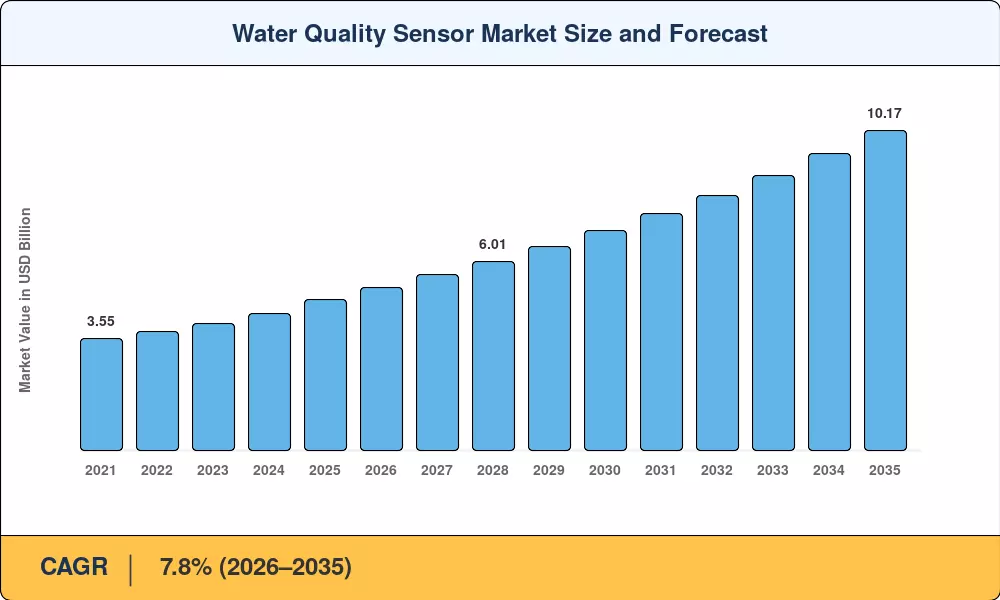
Water Quality Sensor Market Size
North America accounted for USD 1.63 billion in 2025, with the U.S. contributing over 82% of regional revenue
NY, CA, UNITED STATES, June 17, 2026 /EINPresswire.com/ -- The Water Quality Sensor Market reached an estimated USD 4.80 billion in 2025 and is projected to grow from USD 5.17 billion in 2026 to USD 10.17 billion by 2035, registering a CAGR of 7.8% during the forecast period.Water Quality Sensor Market Overview
The Water Quality Sensors Market encompasses a diverse range of sensing devices used to measure and monitor various parameters that determine water quality. These sensors are deployed to detect chemical concentrations, physical properties, and the presence of contaminants in water. By providing critical data on variables such as pH, dissolved oxygen, turbidity, conductivity, temperature, and the presence of specific ions or biological agents, water quality sensors serve as essential tools for protecting public health and ensuring the safety of water resources.
The market's growth is driven by several converging factors. Escalating global concerns over water pollution, a direct result of rapid urbanization and industrial activity, have made quick and reliable contamination detection a priority. Stringent government regulations, including the U.S. Clean Water Act and Safe Drinking Water Act, European Union directives, and initiatives like China's "Water Ten Articles," are compelling industries and utilities to adopt advanced monitoring solutions to ensure compliance. Furthermore, significant technological advancements, such as the integration of IoT for real-time data transmission, AI-powered analytics for predictive maintenance, and the miniaturization of sensors, have made monitoring more effective and accessible.
Key industry trends include a decisive shift from traditional, manual sampling towards continuous, automated monitoring systems. The market is seeing a growing demand for multi-parameter sensors capable of measuring several water quality indicators simultaneously, a category projected to grow at a CAGR of 7%-9%. The rise of portable and handheld instruments is also democratizing field diagnostics, empowering stakeholders in remote or resource-constrained areas. This evolution reflects a broader transition towards data-driven water management, where decision-makers rely on persistent environmental intelligence to optimize treatment processes and safeguard public health.
Get Free Sample Report for Detailed Market Insights:
https://www.marketresearchfuture.com/sample_request/25366
Water Quality Sensor Market Segmentation
The Water Quality Sensor Market is segmented by product type, technology, component, end user, and region.
By Product Type:
Laboratory/Benchtop Sensors: High-precision instruments used for regulatory compliance, research, and detailed analysis. They are characterized by high accuracy and the ability to detect complex contaminants.
Portable/Handheld Sensors: Devices used for field testing. These are rugged, user-friendly, and increasingly popular for rapid incident triage and on-site diagnostics.
Online/Process Monitors: Integrated into water treatment plants or industrial processes for continuous, real-time monitoring and automated control.
Multi-Parameter Sondes: Advanced probes capable of logging multiple parameters like pH, DO, temperature, turbidity, and ORP simultaneously, often deployed for surface and groundwater monitoring.
By Component (Sensor Type):
pH Sensors: Measure acidity or alkalinity, a fundamental parameter in water quality.
Dissolved Oxygen (DO) Sensors: Crucial for assessing the health of aquatic ecosystems and for wastewater treatment processes.
Turbidity Sensors: Measure water clarity and the presence of suspended particles; a key indicator of contamination.
Temperature Sensors: Monitor thermal pollution and support other sensor readings.
Conductivity Sensors: Measure the ionic content of water, providing an indirect measure of dissolved solids.
By End User:
Utility (Municipal): For monitoring potable water, wastewater treatment, and distribution networks to ensure compliance and public safety.
Industrial: For wastewater discharge compliance, process optimization, and cooling water monitoring in sectors like oil & gas, pharmaceuticals, and food & beverage.
Agricultural Sector: For monitoring irrigation water quality and controlling nutrient runoff.
Aquaculture: For monitoring water conditions in fish farms to maintain health and optimize yields.
Household/Residential: For point-of-use testing to ensure drinking water safety.
By Region:
North America, Europe, Asia-Pacific, Latin America, Middle East & Africa.
You can buy this market report at:
https://www.marketresearchfuture.com/checkout?currency=one_user-USD&report_id=25366
Water Quality Sensor Market Regional Analysis
Asia-Pacific: This region dominates the global water quality sensor market, driven by high adoption rates in water and wastewater treatment applications. China is a major contributor, with its extensive water monitoring network of thousands of automatic surface water stations and policies like the "Water Ten Articles" mandating stricter pollution controls. India is a significant emerging market, where rapid urbanization, industrial expansion, and government initiatives for clean water are fueling demand. Countries like Japan and South Korea also play a key role, with Japan's focus on environmental monitoring intensifying following events like the Fukushima wastewater release.
North America: A mature market, led by the United States, where strict regulations like the Clean Water Act and Safe Drinking Water Act drive demand for advanced monitors in utilities and industries. A key trend here is the upgrading of aging infrastructure, creating a need for modern, digital monitoring solutions. Canada also contributes to growth through groundwater and industrial applications.
Europe: Growth in this region is driven by the European Union's Water Framework Directive and high public awareness, which promotes the adoption of multi-parameter monitoring systems in countries like Germany, France, and the UK.
Middle East & Africa and Latin America: Represent emerging markets with significant potential. In the Middle East and Africa, countries like the UAE and South Africa are investing in water infrastructure, creating opportunities for sensor deployment. In Latin America, Brazil is a key market where industrial and agricultural water management needs are fueling demand.
Water Quality Sensor Market Key Players
The market features a mix of established global leaders and specialized regional players. The competitive landscape is characterized by innovation, with leading firms integrating IoT and AI into their portfolios.
Key companies active in the market include:
Xylem Inc. (US): A leader in water technology, offering a wide range of IoT-enabled sensors and monitors through its brands like YSI for utilities and environmental monitoring.
Thermo Fisher Scientific Inc. (US): Provides advanced laboratory and field instruments for water quality analysis, known for high-precision systems like ion chromatography for detecting complex contaminants.
Hach (US/Danaher): A specialist in drinking water and wastewater analysis, known for robust monitors and user-friendly interfaces.
Horiba, Ltd. (Japan): Renowned for high-precision portable and benchtop instruments for measuring pH, DO, conductivity, and other parameters, crucial for industrial and environmental applications.
ABB Ltd (Switzerland): A major technology firm with a strong presence in industrial process automation, including sophisticated water quality monitoring solutions.
Shimadzu Corporation (Japan): A manufacturer of high-precision multi-parameter monitors and analytical instruments used in laboratory and environmental applications for contaminant detection.
Pentair (US): A player providing water quality monitoring and treatment solutions for various applications, including aquaculture.
Focused Photonics Inc. (China): A Chinese firm providing cost-effective multi-parameter monitors for surface water and industrial applications, catering to the growing demand in Asia.
Strategic developments include partnerships between instrument manufacturers and analytics providers to deliver turnkey monitoring solutions, and investments in modular, interoperable product designs to allow integration into diverse data environments.
Latest Industry News & Developments
China Expands National Surface Water Monitoring Network: In line with its 14th Five-Year Plan, China has significantly expanded its network of automatic surface water monitoring stations (from 972 in 2015 to thousands), representing a massive deployment of water quality sensors.
U.S. Tariffs Impact Supply Chain Dynamics: Tariff-driven increases in the landed cost of imported microelectronics and specialized components have compelled manufacturers to reassess sourcing strategies and explore reshoring or alternative regional suppliers to mitigate risks and costs.
India’s Infrastructure-Driven Economy Fuels Demand: With initiatives for clean water and rapid urbanization, India's focus on infrastructure and smart water management systems is creating a surge in demand for water quality sensors.
Water Quality Sensor Market Challenges & Opportunities
Key Restraints: The high upfront cost of advanced multi-parameter sensors and IoT-enabled systems remains a barrier, especially in cost-sensitive markets. Regulatory complexity, with diverse standards across regions, adds to compliance costs for manufacturers. Supply chain disruptions, such as semiconductor shortages, can impact production and delivery timelines. Sensor drift and the need for regular calibration represent ongoing operational costs.
Emerging Opportunities: The integration of AI and big data analytics for predictive maintenance and anomaly detection presents a significant value-add for smart sensors. The transition towards "sensor as a service" models, where sensors are offered with data subscription services, is creating recurring revenue streams. The development of low-maintenance, anti-fouling sensors with low-power IoT communication modules is expanding deployment possibilities for remote, long-term monitoring.
Future Potential: The water quality sensor market is on a clear growth trajectory, driven by the fundamental need to safeguard precious water resources. As technology makes sensors smarter and more affordable, their deployment will expand from traditional utilities to agricultural, aquaculture, and residential settings. The future lies in "data-driven water management," where interconnected sensor networks provide the intelligence necessary to combat pollution, conserve resources, and protect public health.
To explore more market insights, visit us at:
https://www.marketresearchfuture.com/reports/water-quality-sensor-market-25366
The Water Quality Sensor Market is projected to grow from USD 5.17 billion in 2026 to USD 10.17 billion by 2035 at a CAGR of 7.8%. This growth is driven by the urgent global need to combat water pollution, enforce stringent government regulations, and leverage technological advancements in IoT and AI. Asia-Pacific, led by China's massive environmental monitoring initiatives, dominates the regional landscape, while North America and Europe maintain mature markets focused on infrastructure upgrades and regulatory compliance.
Key players are innovating to provide more integrated, smart monitoring solutions. While challenges such as high costs and regulatory complexity remain, the market outlook is robust, underpinned by the rising global population and the paramount importance of water security. The transition from manual sampling to real-time, networked monitoring systems will be a defining trend over the forecast period.
More Related Reports from MRFR Library:
Carbon Credit Trading Platform Market https://www.marketresearchfuture.com/reports/carbon-credit-trading-platform-market-13893
Energy Transition Market https://www.marketresearchfuture.com/reports/energy-transition-market-13894
Asia Pacific Energy Storage Market https://www.marketresearchfuture.com/reports/asia-pacific-energy-storage-market-16166
ASEAN Energy Transition Market https://www.marketresearchfuture.com/reports/asean-energy-transition-market-16199
Remote Power System Market https://www.marketresearchfuture.com/reports/remote-power-system-market-19249
India Fuel Station Market https://www.marketresearchfuture.com/reports/india-fuel-station-market-21398
Europe Heat Pump Market https://www.marketresearchfuture.com/reports/europe-heat-pump-market-21628
Middle East and Africa Renewable Energy Market https://www.marketresearchfuture.com/reports/mea-renewable-energy-market-21679
Asia Pacific Sustainable Aviation Fuels Market https://www.marketresearchfuture.com/reports/apac-sustainable-aviation-fuels-market-21683
Europe Sustainable Aviation Fuels Market https://www.marketresearchfuture.com/reports/europe-sustainable-aviation-fuels-market-21684
Larry Wilson
WantStats Research And Media Pvt. Ltd.
+1 855-661-4441
email us here
Visit us on social media:
LinkedIn
Facebook
YouTube
X
Legal Disclaimer:
EIN Presswire provides this news content "as is" without warranty of any kind. We do not accept any responsibility or liability for the accuracy, content, images, videos, licenses, completeness, legality, or reliability of the information contained in this article. If you have any complaints or copyright issues related to this article, kindly contact the author above.
