

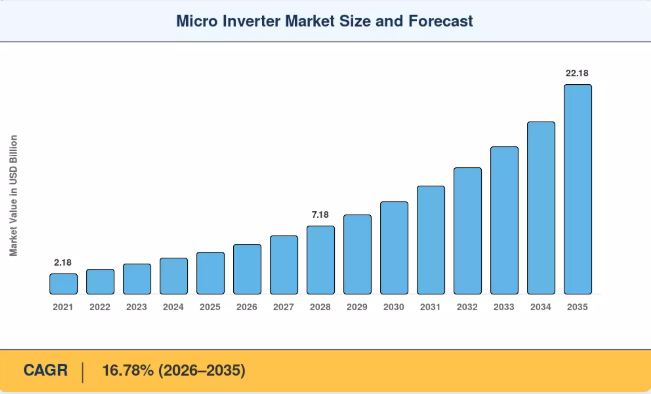
Micro Inverter Market reached an estimated USD 22.18 Billion with 16.78% CAGR during 2025–2035
Micro Inverter Market
Micro Inverter Market Size, Share and Research Report By Phase Type (Single-Phase, Three-Phase), By Communication Technology (Wired, Wireless), By Component
Micro Inverter Market: Growing rapidly due to rising solar adoption and demand for efficient module-level power optimization in renewable energy systems.”
BUSAN, BUSAN, SOUTH KOREA, June 25, 2026 /EINPresswire.com/ -- The Global micro inverter market reached an estimated USD 4.46 billion in 2025 and is projected to grow from USD 5.27 billion in 2026 to USD 22.18 billion by 2035, registering a CAGR of 16.78% during the forecast period. Two major catalysts are driving this expansion: accelerating residential and commercial rooftop solar installations worldwide with global solar PV capacity additions surpassing 450 GW in 2024 and the growing preference among installers and homeowners for module-level power electronics that deliver superior energy yield, enhanced safety, and simplified system design compared with traditional string inverter architectures. — Market Research Future (MRFR)
With panel-level shading mitigation, real-time performance monitoring, and rapid shutdown compliance becoming standard expectations in distributed solar markets, microinverters are increasingly the default choice for residential and small commercial installations across North America, Europe, and emerging Asia-Pacific markets.
Conventional centralized and string inverter systems are steadily losing ground to microinverter architectures that convert DC to AC power at the individual panel level, eliminating the system-wide performance losses caused by partial shading, panel mismatch, and orientation variance. A recent National Renewable Energy Laboratory (NREL) field study estimated that residential systems using microinverters captured 5–8% higher energy yield annually compared with equivalent string inverter installations in shading-prone environments. This shift is not merely incremental it reflects a structural re-architecture of how distributed solar systems are designed, installed, monitored, and maintained across residential, commercial, and emerging utility-scale applications.
Get Full PDF Sample Copy of Report: (Including Full TOC, List of Tables & Figures, Chart) @
https://www.marketresearchfuture.com/sample_request/12609
➤How Significant Is the Micro Inverter Market’s Growth?
The micro inverter market has demonstrated exceptional and sustained expansion, rising from approximately USD 956.4 million in 2021 to an estimated USD 4.46 billion in 2025, representing a robust historical growth trajectory. The market is projected to nearly quadruple over the next decade, propelled by accelerating residential solar adoption, expanding net metering and feed-in tariff programs across emerging markets, and tightening electrical safety codes mandating rapid shutdown capabilities that microinverters inherently satisfy without additional system components.
Rising electricity costs, growing consumer demand for energy independence, and expanding rooftop solar incentive programs in markets such as the United States, Australia, and parts of Europe have created sustained demand for module-level power electronics. Solar installers, EPC contractors, and residential homeowners increasingly favor microinverter systems for their simplified installation process, panel-level monitoring capabilities, and superior performance in complex roof geometries with multiple orientations, partial shading, or varying panel agesconditions where string inverters experience significant performance degradation.
➤What Does the Future Hold for the Micro Inverter Market?
Smart grid integration and advanced energy management capabilities stand at the forefront of the market’s next growth phase. Next-generation microinverters are evolving beyond simple DC-to-AC conversion into intelligent grid-interactive devices capable of providing reactive power support, frequency regulation, and seamless integration with battery storage systems and home energy management platforms. Utilities increasingly require grid-support functionality such as volt-VAR control and ride-through capability as distributed solar penetration rises, positioning advanced microinverters as essential grid infrastructure rather than standalone conversion devices.
The convergence of microinverters with residential battery storage is another defining force shaping the market’s future. AC-coupled battery systems paired with microinverter-based solar arrays are simplifying retrofit installations and enabling more flexible, modular energy storage deployment compared with DC-coupled hybrid inverter systems. Leading manufacturers are increasingly bundling microinverters with integrated storage and home energy management software, creating comprehensive residential energy ecosystems that extend well beyond traditional solar conversion functionality.
Commercial and light industrial applications represent an expanding frontier for microinverter technology.
While historically concentrated in residential installations, manufacturers are increasingly targeting commercial rooftop and carport applications where panel-level monitoring, enhanced safety compliance, and reduced single-point-of-failure risk offer compelling value propositions. Industry analysts project the commercial microinverter segment will grow at a faster rate than residential applications through 2035 as cost-per-watt gaps with string and central inverter systems continue to narrow.
➤Who Are the Key Players in the Micro Inverter Market?
The micro inverter landscape is characterized by a concentrated group of pioneering technology developers alongside an expanding base of regional and emerging manufacturers. Key participants shaping the competitive dynamics include:
★Enphase Energy — the global pioneer and market leader in microinverter technology, offering the IQ Series with integrated battery storage and home energy management ecosystem capabilities
★APsystems (Altenergy Power System) — a leading global manufacturer offering multi-module microinverters that connect multiple solar panels to a single unit, reducing installation costs
★Hoymiles Power Electronics — a rapidly growing Chinese manufacturer with strong international expansion, offering both single and multi-panel microinverter solutions
★Chilicon Power — providing microinverter systems with a focus on the North American residential and commercial solar markets
SolarEdge Technologies — while primarily known for power optimizer and string inverter architecture, increasingly competing in the module-level power electronics space
★Darfon Electronics — a Taiwan-based manufacturer offering microinverter solutions with growing presence across Asia-Pacific and European markets
★Deye (Ningbo Deye Inverter Technology) — an emerging Chinese manufacturer expanding its microinverter product line alongside its established hybrid and string inverter portfolio
★AEconversion GmbH — a German manufacturer specializing in compact, high-efficiency microinverters for the European residential solar market
★TSUNESS — a Chinese manufacturer offering competitively priced microinverter systems with expanding distribution across emerging solar markets
★Sparq Systems — a Canadian technology developer providing microinverter solutions with a focus on grid-support functionality and advanced power electronics
Competition in the market is intensifying as established leaders defend market share against rapidly scaling Chinese manufacturers offering competitively priced alternatives, particularly across European and emerging market segments. Strategic differentiation increasingly centers on integrated battery storage compatibility, software-driven energy management platforms, multi-panel microinverter designs that reduce per-watt hardware costs, and extended warranty offerings that address long-term reliability concerns in distributed rooftop installations.
★What Are the Emerging Trends in the Micro Inverter Market?
Several transformational trends are redefining how the micro inverter market evolves through 2035:
Multi-Panel Microinverter Architectures: Manufacturers are increasingly shifting from single-panel to multi-panel (2–4 module) microinverter designs that reduce per-watt hardware costs while preserving panel-level monitoring and shading mitigation benefits.
Battery Storage Integration: AC-coupled microinverter-battery ecosystems are simplifying solar-plus-storage retrofits and enabling modular, scalable residential energy storage deployment without requiring DC-coupled hybrid inverter replacement.
Grid-Support & Smart Inverter Functionality: Rising distributed solar penetration is driving utility and regulatory requirements for advanced grid-support features including volt-VAR control, frequency-watt response, and ride-through capability in next-generation microinverter designs.
Expansion into Commercial & C&I Applications: Microinverter manufacturers are increasingly targeting commercial rooftop, carport, and light industrial installations as cost-per-watt economics improve and panel-level monitoring value propositions resonate with commercial asset owners.
Software-Driven Energy Management Platforms: Leading manufacturers are bundling microinverters with cloud-based monitoring, predictive maintenance analytics, and home energy management software, transforming hardware sales into recurring software-enabled revenue streams.
Manufacturing Localization & Trade Policy Response: Tariff measures and domestic content incentives including U.S. Inflation Reduction Act manufacturing credits are driving microinverter manufacturers to localize production across North America and Europe, reshaping global supply chain strategies.
Get access to the full description of the report @
https://www.marketresearchfuture.com/reports/micro-inverter-market-12609
★ How Is the Micro Inverter Market Segmented?
The micro inverter market report provides a comprehensive segmentation framework:
By Phase Type: Single Phase, Three Phase
By Connectivity Type: Standalone, On-Grid/Grid-Tied
By Application: Residential, Commercial, Industrial, Utility-Scale
By Module Configuration: Single-Module, Multi-Module (2–4 Panel)
By Sales Channel: Direct Sales, Distributors, Online/E-commerce
★ What Are the Regional Insights from the Micro Inverter Market?
North America commands approximately 38% of global micro inverter market share, underpinned by the United States’ mature residential solar market, strong rapid shutdown code requirements under NEC 690.12, and the continued dominance of Enphase Energy as the region’s leading microinverter supplier. Federal incentives including the Investment Tax Credit (ITC) and Inflation Reduction Act manufacturing provisions continue to support both installation demand and domestic microinverter production capacity across the region.
Europe holds a significant share of the global market, with Germany, the Netherlands, the United Kingdom, and Italy representing the primary markets. Rising electricity prices, strong residential solar adoption rates, and growing preference for module-level power electronics in complex urban rooftop installations are driving sustained microinverter demand. The region has also become a key battleground between established Western manufacturers and rapidly expanding Chinese microinverter suppliers offering competitive pricing.
Asia-Pacific represents the fastest-growing region, driven by China’s massive domestic solar manufacturing base, India’s expanding rooftop solar program under the PM Surya Ghar scheme, and rapidly increasing residential solar adoption across Australia, where high electricity costs and strong solar irradiance have made rooftop solar with microinverter systems particularly attractive. China is additionally home to several of the fastest-growing global microinverter manufacturers, including Hoymiles, Deye, and TSUNESS.
Latin America is projected to register a strong CAGR through 2035, driven by Brazil’s rapidly expanding distributed generation solar market and Mexico’s growing residential and commercial rooftop installations. Favorable net metering policies and declining solar equipment costs are accelerating microinverter adoption across the region’s residential solar segment.
The Middle East & Africa region rounds out the global picture, with the UAE and Saudi Arabia leading adoption in commercial and utility-scale distributed solar applications, while South Africa’s ongoing grid reliability challenges are driving strong residential demand for solar-plus-storage systems incorporating microinverter technology as a resilient, modular power solution.
➤➤➤ Market Research Future's Regional Market Analysis:
Us Micro Inverter Market-
https://www.marketresearchfuture.com/reports/us-micro-inverter-market-17290
➤➤➤ Industry Analysis Reports by Market Research Future:
Intelligent Platform Management Interface Market-
https://www.marketresearchfuture.com/reports/intelligent-platform-management-interface-market-2997
Large Format Display Market-
https://www.marketresearchfuture.com/reports/large-format-display-market-3184
Traffic Management Market-
https://www.marketresearchfuture.com/reports/traffic-management-market-3199
Thermal Management Market-
https://www.marketresearchfuture.com/reports/thermal-management-market-3201
Wireless Fire Detection System Market-
https://www.marketresearchfuture.com/reports/wireless-fire-detection-system-market-3247
Optical Sensing Market-
https://www.marketresearchfuture.com/reports/optical-sensing-market-3260
5K Display Resolution Market-
https://www.marketresearchfuture.com/reports/5k-display-resolution-market-3275
360 Degree Camera Market-
https://www.marketresearchfuture.com/reports/360-degree-camera-market-3688
Temperature Sensors Market-
https://www.marketresearchfuture.com/reports/temperature-sensors-market-3760
Cnc Controller Market-
https://www.marketresearchfuture.com/reports/cnc-controller-market-3839
Sagar Kadam
Market Research Future
+ +1 628-258-0071
email us here
Legal Disclaimer:
EIN Presswire provides this news content "as is" without warranty of any kind. We do not accept any responsibility or liability for the accuracy, content, images, videos, licenses, completeness, legality, or reliability of the information contained in this article. If you have any complaints or copyright issues related to this article, kindly contact the author above.
