

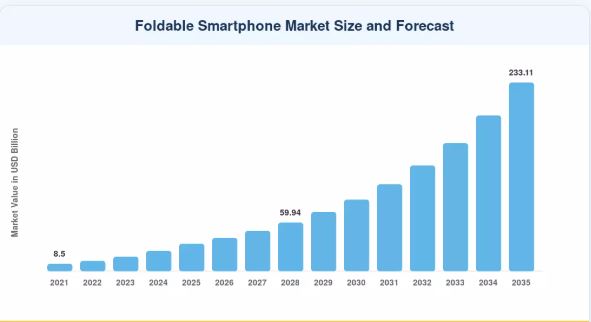
Foldable Smartphone Market to Surge from USD 33.50 Billion in 2025 to USD 233.11 Billion by 2035 at 21.4% CAGR
Foldable Smartphone market
Foldable Smartphone Market Size, Share and Research Report By Form Factor (Book-Style, Clamshell, Rollable / Slide-Out), By Screen Size (≤6.9 Inch
The Foldable Smartphone Market is expanding rapidly as consumers seek innovative, portable devices with larger displays and advanced multitasking capabilities.”
SHANGHAI, SHANGHAI, CHINA, July 31, 2026 /EINPresswire.com/ -- The Global Foldable Smartphone market reached an estimated USD 33.50 billion in 2025 and is projected to open the forecast window at roughly USD 40.67 billion in 2026, climbing to USD 233.11 billion by 2035 at a CAGR of 21.4%. Two catalysts stand behind this trajectory: ultra-thin-glass manufacturing yields crossed the 90% threshold in late 2024, cutting panel costs by roughly a third within twelve months, and carrier-subsidized bundles tied to unlimited 5G data plans pulled flagship foldable devices below the USD 1,500 price point across most mature markets. — Market Research Future (MRFR)
The market's 21.4% CAGR reflects the combined pull of display cost deflation from UTG and polymer manufacturing (~25% CAGR impact), carrier subsidy and installment financing (~20%), enterprise productivity deployment (~18%), and 5G-Advanced and Wi-Fi 7 synergy (~12%) advancing together across consumer and enterprise channels.
A generational shift in display technology is underway. Rigid slab-style smartphones that dominated the last decade are now competing against devices that fold, flip, and in emerging prototypes roll outward to deliver tablet-class screen real estate in a pocket-friendly chassis. Samsung's cumulative multi-billion-dollar investment in flexible OLED fabrication since 2019 has been matched by aggressive capex from BOE and CSOT in China, creating enough supply-side momentum to sustain double-digit annual price erosion in foldable display modules through 2028. Asia-Pacific commands 58.1% of the global foldable smartphone market revenue, anchored by South Korea's manufacturing dominance and China's rapidly expanding consumer base.
The Middle East & Africa region is accelerating at the fastest clip a 25.2% CAGR through 2035 fueled by young demographics and carrier-financed upgrade cycles, while North America holds the second-largest revenue share at 17.8%, driven by premium-tier demand and enterprise pilot deployments. The decade ahead will test whether productivity-driven enterprise adoption can match consumer enthusiasm as a growth engine for the foldable smartphone market.
Get Full PDF Sample Copy of Report: (Including Full TOC, List of Tables & Figures, Chart) @
https://www.marketresearchfuture.com/sample_request/42509
➤ How Significant Is the Foldable Smartphone Market's Growth?
The foldable smartphone market's trajectory from USD 33.50 billion in 2025 to a projected USD 233.11 billion by 2035 represents nearly a seven-fold expansion over the forecast decade, reflecting the structural shift from rigid slab-style devices toward flexible-display architectures as a mainstream, rather than niche, smartphone category. The market's 21.4% CAGR is anchored in a display-cost supercycle where ultra-thin-glass yield improvements, carrier subsidy programs, and enterprise productivity pilots are converging to pull foldables out of the ultra-premium tier and into mainstream purchase consideration.
Book-style devices captured an estimated 66.5% of 2025 revenue, reflecting consumer preference for expansive inner displays that replace tablet workflows, while rollable and slide-out form factors are forecast to grow at the fastest pace through 2035 on the back of new design patents from Samsung and LG Display. The 7–8 inch screen-size category contributed 47.2% of 2025 revenue as split-screen multitasking became a primary purchase driver, and devices priced between USD 1,500 and USD 1,999 are advancing at a 24.2% CAGR, outpacing both budget and ultra-premium tiers. Asia-Pacific led the market with 58.1% of 2025 revenue, while the Middle East & Africa region posted the highest projected CAGR of 25.2%, and North America and Europe remain premium strongholds where average selling prices exceed the global mean by 18–22%.
➤ What Does the Future Hold for the Foldable Smartphone Market?
Display cost deflation contributes approximately 25% to the foldable smartphone market's CAGR the single highest driver impact. Between 2022 and 2025, Samsung Display and BOE invested more than USD 4.2 billion in Gen 8.5 flexible OLED lines, increasing UTG yield rates above 90% and lowering panel costs for foldable smartphones by almost 30% annually, a cost compression that allowed three new clamshell models priced under USD 1,000 to launch in Western markets in 2025 alone.
Carrier subsidy and installment financing contributes approximately 20% to the CAGR, with Verizon, T-Mobile, and Deutsche Telekom expanding foldable-specific trade-in programs in 2024 that offered up to USD 800 in credit toward devices priced above USD 1,200, reducing effective out-of-pocket cost to below USD 600 for qualifying customers and driving a 38% increase in carrier-channel sell-through during the holiday quarter. Enterprise productivity deployment adds a further 18%, as pilot programs at DHL, FedEx, and Siemens using book-style foldables with split-screen ERP interfaces showed a 22% improvement in task-completion times a proof point that is now shifting enterprise procurement budgets toward foldable hardware on an 18-to-24-month adoption lag behind consumer trends. 5G-Advanced and Wi-Fi 7 synergy contributes approximately 12%, as network-slicing capabilities that support simultaneous high-bandwidth streams on split-screen layouts are a use case tailor-made for book-style foldables.
The next product generation is shifting toward AI-integrated on-device experiences: Qualcomm's Snapdragon 8 Gen 4 and MediaTek's Dimensity 9400 bring dedicated NPUs capable of 75+ TOPS to foldable devices, enabling real-time translation, generative-AI photo editing, and context-aware app continuity across fold states. LG Display and Samsung Display have also demonstrated commercially viable rollable OLED panels that extend screen area by 60% without a visible crease, with first-generation rollable smartphones expected to reach retail by 2027 and open a premium sub-segment targeting early adopters willing to pay above USD 2,000.
Get access to the full description of the report @
https://www.marketresearchfuture.com/reports/foldable-smartphone-market-42509
➤ Who Are the Key Players in the Foldable Smartphone Market?
The foldable smartphone market exhibits medium concentration, with Samsung holding a commanding but gradually eroding lead while Huawei, Xiaomi, and OPPO intensify competition through aggressive pricing and rapid product-cycle cadences. The top five players collectively control an estimated 75–82% of global revenue, and new entrants face steep barriers in flexible-display procurement and hinge-mechanism IP. MRFR identifies the following key participants with estimated revenue share ranges:
Samsung Electronics (~28–33% share) - the vertically integrated display-to-device leader with the Galaxy Z Fold and Galaxy Z Flip series, combining in-house flexible OLED production with the broadest deployed base of book-style and clamshell foldables globally.
Huawei (~15–19% share) - the domestic China champion with the Mate X and Pocket series, benefiting from Harmony OS lock-in and a resurgence in mainland shipments that is eroding Samsung's local share.
Xiaomi (~8–12% share) - a cost-leadership specialist with the Mix Fold series, targeting the sub-USD 1,000 tier and pushing launch prices for book-style foldables to new lows in China.
OPPO (~7–10% share) - an ultra-thin hinge innovation leader with the Find N series, holding design patents on waterdrop-hinge mechanisms that reduce crease depth versus prior generations.
Motorola / Lenovo (~5–8% share) - a heritage-brand revitalization story in the clamshell segment through the Razr series, reinforced by exclusive carrier trade-in partnerships in the US.
Google (~3–5% share) - an Android-native optimization and AI-integration specialist with the Pixel Fold, shaping continuity APIs that benefit the broader foldable app ecosystem.
Honor (~3–5% share) - a post-Huawei spinoff capturing mid-premium demand with the Magic V series across Asia-Pacific and select European markets.
OnePlus (~2–4% share) - an enthusiast-community-focused entrant with the Open series, competing on aggressive pricing relative to flagship peers.
vivo (~2–4% share) - a camera-centric differentiator with the X Fold series, leveraging vivo's broader imaging technology stack.
Tecno / Transsion (~1–3% share) - an emerging-market value proposition provider with the Phantom V series, targeting first-time foldable buyers across Africa and South Asia.
Strategic competition in the foldable smartphone market is increasingly defined by hinge-mechanism durability and crease depth, flexible-display supply-chain access, carrier subsidy partnerships, and the pace at which OEMs can push AI-native on-device experiences to differentiate beyond raw hardware specifications.
➤ What Are the Emerging Trends in the Foldable Smartphone Market?
Several transformational trends are redefining the foldable smartphone market's evolution through 2035:
AI-Integrated On-Device Experiences: Dedicated NPUs capable of 75+ TOPS are bringing real-time translation, generative-AI photo editing, and context-aware app continuity across fold states, positioning foldables to differentiate on AI capability rather than raw hardware specifications as these chips become standard by 2028.
Rollable and Slidable Form Factors: Commercially viable rollable OLED panels that extend screen area by 60% without a visible crease are moving toward retail by 2027, opening a premium sub-segment within the foldable smartphone market that targets early adopters willing to pay above USD 2,000.
Sustainability and Circular-Economy Pressure: The European Commission's Ecodesign for Sustainable Products Regulation, effective 2027, will mandate minimum repairability scores and recycled-content thresholds, pushing OEMs to invest in modular hinge assemblies and take-back programs to maintain EU market access.
Enterprise-Grade Security and MDM Integration: An estimated 18% of enterprise smartphone fleets are projected to include at least one foldable device type by 2030, up from under 4% in 2025, as Knox, Android Enterprise, and emerging zero-trust frameworks adapt to dual-screen workflows in healthcare, finance, and government.
Mid-Range Price Disruption Below USD 700: Chinese OEMs including Xiaomi and OPPO have signaled plans to introduce foldable devices below USD 700 by 2027, targeting the 1.2-billion-unit mid-range smartphone segment that currently has negligible foldable penetration.
Foldable-Native Content and App Platforms: Continuity APIs that let apps transition seamlessly between folded and unfolded states are creating a developer incentive loop, and as the installed base crosses 120 million units, content providers are increasingly designing foldable-first experiences in gaming, video editing, and telemedicine.
Buy Full Research Report:
https://www.marketresearchfuture.com/checkout?currency=one_user-USD&report_id=42509
➤ How Is the Foldable Smartphone Market Segmented?
The foldable smartphone market report provides a comprehensive segmentation framework:
By Form Factor: Book-Style (66.5% share, 2025), Clamshell (28.3% share, 2025), Rollable / Slide-Out (22.1% CAGR)
By Screen Size: ≤6.9 Inch, 7–8 Inch (47.2% share, 2025), More Than 8 Inch (23.5% CAGR)
By Price Range: Less Than USD 1,000, USD 1,000–1,499 (52.1% share, 2025), USD 1,500 and Above (24.2% CAGR)
By Sales Channel: Carrier / Operator (55.4% share, 2025), Consumer Electronics Retail, E-commerce / DTC (22.3% CAGR)
By End User: Consumer (67.3% share, 2025), Government / Defense & Enterprise (24.0% CAGR)
By Region: Asia-Pacific (58.1%), North America (17.8%), Europe (14.9%), South America (5.1%), Middle East & Africa (25.2% CAGR)
➤ What Are the Regional Insights from the Foldable Smartphone Market?
Asia-Pacific leads the foldable smartphone market with 58.1% of 2025 revenue, with China alone accounting for nearly half of the region's revenue, propelled by Huawei's Mate X series comeback and aggressive pricing from Xiaomi, OPPO, and vivo. South Korea is growing at a 19.5% CAGR on Samsung's home-market premium positioning, India is expanding at a 22.8% CAGR through sub-USD 800 clamshells and Flipkart promotions, and Japan contributes through NTT Docomo bundling programs. Samsung retains its global lead but faces share erosion in mainland China, where domestic brands benefit from local supply chains and Harmony OS ecosystem stickiness.
North America holds the second-largest revenue share at 17.8%, with the United States commanding 78.3% of regional revenue through carrier trade-in programs and enterprise MDM deployments. T-Mobile and AT&T collectively shipped an estimated 4.8 million foldable units in 2025, with enterprise deals at Fortune 500 companies accounting for a growing share of premium-tier activations. Canada contributes 14.1% of regional share through Samsung and Google retail partnerships, and Mexico adds 7.6% through expanding installment financing.
Europe accounts for 14.9% of global market share, with Germany commanding 23.6% of regional revenue through corporate fleet procurement and the United Kingdom contributing 20.8% through premium consumer upgrade cycles. EU right-to-repair directives are shaping the region's market as OEMs are pressured to extend device lifespans and publish repairability scores Samsung and Motorola have responded with modular hinge designs that reduce screen-replacement time from 90 to 35 minutes at authorized service centers. France, Italy, Spain, and the Nordic countries round out the region through operator bundle promotions, design-conscious consumer segments, and high digital-adoption rates respectively.
South America and the Middle East & Africa represent smaller but fast-growing shares of global revenue. Brazil commands 62.4% of South American revenue as Claro and Vivo roll out 36-month financing plans that bring monthly payments for a Galaxy Z Flip below BRL 120, making foldable devices accessible to mid-income consumers for the first time. The Middle East & Africa is the fastest-growing territory worldwide at a 25.2% CAGR, benefiting from median ages below 30 and carrier willingness to subsidize premium devices as a churn-reduction strategy Saudi Arabia holds 28.7% of regional revenue through Vision 2030 digital adoption programs, the UAE contributes 24.1% through high per-capita smartphone spend, and South Africa and Egypt are building out installment-financed adoption through Vodacom programs and expanding 4G/5G infrastructure.
➤➤➤ Regional & Country-Level Reports by Market Research Future:
US Foldable Display Market -
https://www.marketresearchfuture.com/reports/us-foldable-display-market-16416
➤➤➤ Related Reports by Market Research Future:
Smart Key Market
https://www.marketresearchfuture.com/reports/smart-key-market-42147
Emergency Location Transmitter Market
https://www.marketresearchfuture.com/reports/emergency-location-transmitter-market-42365
8 Bit Microcontroller Market
https://www.marketresearchfuture.com/reports/8-bit-microcontroller-market-42493
Flexible Printed Electronic Market
https://www.marketresearchfuture.com/reports/flexible-printed-electronic-market-42505
Fitness Ring Market
https://www.marketresearchfuture.com/reports/fitness-ring-market-42515
Revenue Assurance Market
https://www.marketresearchfuture.com/reports/revenue-assurance-market-42658
Rectifier Market
https://www.marketresearchfuture.com/reports/rectifier-market-42661
Hazardous Location Thermostats Market
https://www.marketresearchfuture.com/reports/hazardous-location-thermostats-market-42664
Rf Front End Module Market
https://www.marketresearchfuture.com/reports/rf-front-end-module-market-42674
Laboratory Electronic Balance Market
https://www.marketresearchfuture.com/reports/laboratory-electronic-balance-market-42675
Sagar Kadam
Market Research Future
+ + +1 628-258-0071
email us here
Legal Disclaimer:
EIN Presswire provides this news content "as is" without warranty of any kind. We do not accept any responsibility or liability for the accuracy, content, images, videos, licenses, completeness, legality, or reliability of the information contained in this article. If you have any complaints or copyright issues related to this article, kindly contact the author above.
